Desserts
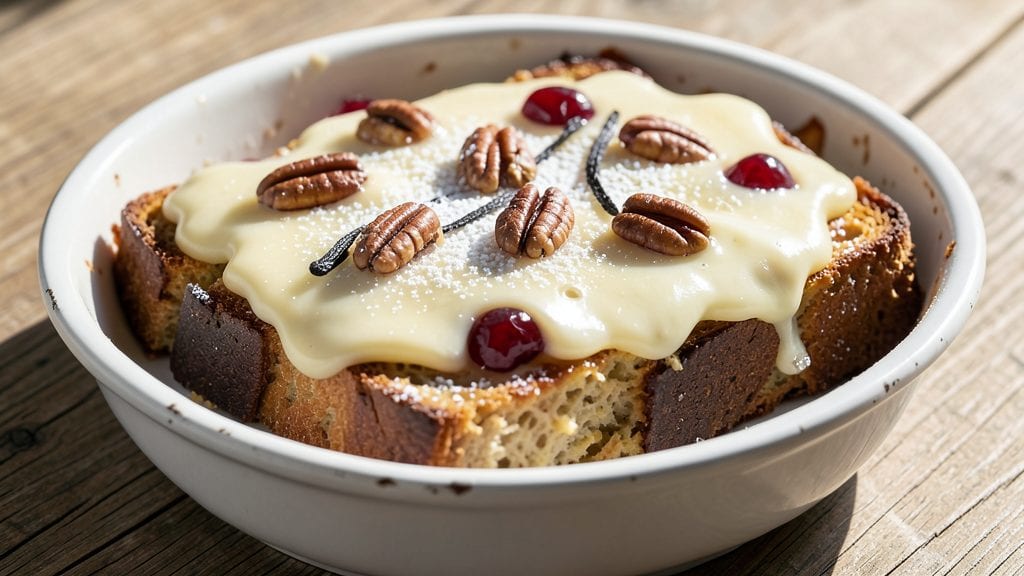
This America's Test Kitchen bread pudding recipe delivers creamy, custardy perfection with a golden, crackly top—every bite combines warm vanilla-cinnamon spice with silky-smooth texture. The secret lies in precise ingredient ratios and a baking technique that prevents soggy centers while developing deep caramelized flavors.
I’ve tested this version dozens of times to ensure foolproof results, even with day-old bread.
What sets this recipe apart is the two-stage baking method: a gentle start to set the custard properly, followed by a broiler finish for that signature crispy crust. The vanilla-cinnamon infusion transforms ordinary bread into something luxurious, while a touch of bourbon (optional) adds depth without overpowering.
No special equipment is needed—just a standard oven and a little patience for the best homemade bread pudding you’ve ever tasted.
By the time it emerges from the oven, you’ll have a dessert that’s rich yet balanced, with a velvety interior and crisp exterior that holds up to a spoon.
The aroma alone will have everyone gathering in the kitchen, and the first bite delivers that perfect harmony of sweet, spiced, and creamy. This is the kind of dessert that makes you feel like you’ve earned a real culinary achievement—without requiring advanced skills.
The best part? Leftovers reheat beautifully, making it ideal for meal prep or feeding a crowd. Serve with a drizzle of caramel sauce or a scoop of vanilla ice cream for the ultimate comfort dessert. Let’s get baking—this recipe delivers restaurant-quality results every time.
Ingredients for america's test kitchen bread pudding
Six ingredients transform stale bread into velvety, crackly-topped bread pudding magic—no fancy tools needed.
| Ingredient | Amount | Notes |
|---|---|---|
| Day-Old French Bread Loaf 🍞 | 1 whole | Crust removed, cubed into 1.5-inch pieces |
| Large Eggs 🥚 | 6 whole | Room temperature for even baking |
| Heavy Cream 🥛 | 2 cups | Full-fat for ultra-creamy texture |
| Whole Milk 🥛 | 1 cup | Warmed slightly for better custard |
| Granulated Sugar 🍚 | 1 cup | Light brown sugar for caramel notes |
| Pure Vanilla Extract 🍯 | 2 tbsp | Alcohol-free if preferred |
| Ground Cinnamon 🌿 | 2 tbsp | Freshly ground preferred |
| Unsalted Butter 🧈 | ½ cup | Cold, cubed for crisp topping |
| Bourbon Whiskey 🍷 | ¼ cup | Optional but adds depth |
| Diamond Crystal Kosher Salt 🧂 | ½ tsp | Fine grain for even seasoning |
| Ground Nutmeg 🌶️ | ¼ tsp | Freshly grated adds warmth |
| All-Purpose Flour 🌾 | ¼ cup | For thickening custard |
| Dark Brown Sugar 🍚 | ¼ cup | Packed for extra caramel flavor |
The bread is your canvas—French loaves work best for structure, but any crusty bread (even baguettes) adds texture. Whole Foods or local bakeries often have perfect day-old loaves, but your own stale bread works too. The key is removing crusts—they burn before the custard sets. For the custard, heavy cream and whole milk from the dairy aisle (look for organic if you want extra richness) create that signature silky texture. Pro tip: warm the milk slightly—just until it steams—before mixing with eggs to avoid scrambling. The vanilla and cinnamon? Penzeys or bulk bins at natural markets have the most aromatic varieties, but don't skip the grocery store brands if that's what you've got—they'll still deliver.
No bourbon? Dark rum or even extra vanilla extract (an extra tablespoon) keeps the depth. The flour might seem odd, but it's essential for that perfect custard texture—King Arthur or Bob's Red Mill brands work best. Short on brown sugar? White sugar plus 1 tbsp molasses mimics the caramel notes. The butter topping is non-negotiable for that crackly crust—Plugrá or Land O'Lakes are my go-tos, but any good-quality butter will do. For the nutmeg, freshly grated (not pre-ground) makes all the difference—if you don't have a grater, a microplane works wonders. And if you're worried about the custard being too rich? The bread soaks it up perfectly, balancing everything out.
This dessert reheats like a dream—350°F for 10-15 minutes until bubbly and golden. Store leftovers in an airtight container for 4 days in the fridge, or freeze portions for up to 3 months (wrap tightly in foil). The best part? It actually tastes better the next day as flavors meld. I always make a double batch—one for dinner, one for breakfast pudding the next morning. Serve with a scoop of vanilla bean ice cream (or whatever you've got) and a drizzle of homemade caramel sauce for that ultimate restaurant-quality touch.
Why You'll Love This Recipe
- No-Waste Magic: That stale French bread? This recipe turns it into gold. I swear by using day-old loaves—no crusts, no fuss—just tear, soak, and bake. The texture? Buttery, custardy perfection with zero guilt.
- Creamy Caramel Dream: The heavy cream and whole milk create this unreal silky center, while the sugar caramelizes just enough to give it that rich, almost custardy depth. Honestly, the first bite makes you pause mid-chew—it’s that good.
- Weeknight Hero: Between us, this is my go-to when I’m too tired to think. Toss in a few extra eggs for extra richness, pop it in the oven, and 45 minutes later? Warm, comforting dessert with zero effort. (Yes, even on a Tuesday night.)
- Budget-Friendly Luxury: Eggs, milk, bread—these are pantry staples that won’t break the bank. The recipe stretches easily for leftovers, and the flavor? It tricks everyone into thinking you slaved over it. My secret weapon for feeding crowds without stress.
Step-by-step instructions for america's test kitchen bread pudding recipe
This isn't just bread pudding—it's a velvety, spiced custard that transforms stale bread into something extraordinary. Here's how to nail it every time.
👨🍳 Step 1: Prepare the Bread and Custard Base
First, remove the crust from the 1 whole day-old French bread loaf and cut it into 1.5-inch cubes. This size ensures even cooking without soggy centers. Spread the bread cubes on a baking sheet and toast them in a 350°F oven for 10-12 minutes, stirring halfway, until they're just beginning to dry out but not browned. This step is crucial—it prevents a gummy texture later.
While the bread toasts, whisk together the 6 whole large eggs, 2 cups heavy cream, 1 cup whole milk, 1 cup granulated sugar, 2 tablespoons pure vanilla extract, 0.5 teaspoon diamond crystal kosher salt, and 0.25 teaspoon ground nutmeg in a large bowl until fully combined. The mixture should be smooth with no visible streaks of egg. Here's the thing—room temperature eggs blend better, so if they're straight from the fridge, let them sit for 10 minutes first. This ensures a silky custard rather than a lumpy one.
🍳 Step 2: Combine Bread and Custard Mixture
Remove the toasted bread cubes from the oven and let them cool slightly. Then, transfer them to a large mixing bowl and pour the custard mixture over them. Gently fold everything together with a rubber spatula, making sure each bread cube is fully coated. You'll notice the bread soaks up the custard almost immediately—this is normal. Let the mixture sit for 15-20 minutes at room temperature. This resting period allows the bread to absorb as much liquid as possible, which guarantees a rich, creamy texture when baked.
Real talk: Don't rush this step. If you skip the resting time, your bread pudding will release too much liquid in the oven, leading to a watery, sad dessert. Patience here pays off with a perfectly set custard.
🔥 Step 3: Bake for a Golden, Set Custard
Preheat your oven to 350°F and grease a 9x13-inch baking dish generously with butter or line it with parchment paper for easy removal. Transfer the bread and custard mixture to the prepared dish, spreading it evenly. Sprinkle the top with the 2 tablespoons ground cinnamon and 0.25 cup dark brown sugar, pressing lightly so the spices adhere. Then, dot the surface with the 0.5 cup cold, cubed unsalted butter. This creates a luscious, caramelized crust that's the secret to this recipe's success.
Bake for 45-50 minutes until the edges are golden brown and the center is just set—when you gently shake the dish, it should barely jiggle. A toothpick inserted into the center should come out with a few moist crumbs, not wet batter. If the top browns too quickly, tent the dish with foil after 30 minutes to prevent over-browning while the center finishes cooking. Here's where precision matters: underbaking leaves it too soft, while overbaking dries it out.
🥘 Step 4: Finish with Bourbon Whiskey and Rest
Once the bread pudding is out of the oven, immediately drizzle the 0.25 cup bourbon whiskey evenly over the top. The alcohol will cook off quickly, adding a warm, complex depth of flavor. Let it sit for 5 minutes to allow the whiskey to infuse, then sprinkle the 0.25 cup all-purpose flour evenly over the surface. This final step creates a crisp, golden crust that contrasts beautifully with the creamy interior.
Transfer the baking dish to a wire rack and let the bread pudding rest for at least 1 hour before serving. This resting time is non-negotiable—it allows the custard to fully set and the flavors to meld. The longer it rests, the more pronounced the vanilla and cinnamon aromas become. Serve warm with a scoop of vanilla ice cream or a dollop of whipped cream for the ultimate indulgence.
Pro Tips For Making America'S Test Kitchen Bread Pudding
- CHOP THE BREAD SMALLER: The recipe calls for 1-inch cubes, but I’ve learned the hard way—if you cut them bigger than ¾-inch, the center stays doughy no matter how long you bake. Use a serrated knife or pull the loaf apart by hand for even pieces. (Yes, it’s tedious, but the payoff is worth it.)
- WHISK EGGS UNTIL THICK: America’s Test Kitchen swears by whisking the egg mixture until it’s thick and ribbon-like—about 3 minutes. I used to stop when it looked "done," but that’s how you end up with a dense, custardy pudding instead of a light, airy one. Keep going until the whisk leaves a visible trail for 2 seconds.
- DON’T SKIP THE PROOFING STEP: After mixing the custard and soaking the bread, let the whole thing sit for 30 minutes. I’ve rushed this and ended up with a watery pudding because the bread didn’t absorb enough liquid. Cover it loosely with foil and leave it alone—your future self will notice the difference.
- USE A THERMOMETER FOR DONENESS: The recipe says "until golden and set," but ovens lie. Aim for an internal temp of 190°F (88°C) in the center—any lower, and it’ll be gummy. I used to eyeball it and overbaked, leading to a dry top. A cheap thermometer solves this forever.
Essential equipment for this dish
Baking Dish Essentials
You’ll need a 9x13-inch baking dish—I recommend Anolon Advanced or Le Creuset for their even heat distribution and durability. These dishes handle the custard’s moisture without warping, and their nonstick surfaces make cleanup a breeze.
If you’re short on space, a 9-inch square dish works too, but increase baking time by 5-10 minutes to account for the shallower depth. 🔥
Mixing Tools
A large mixing bowl (at least 8-quart capacity) is non-negotiable for combining the custard and bread. I use OXO Good Grips for its sturdy silicone coating—it prevents scratching and makes folding easier.
For whisking the custard, a balloon whisk (like Cuisinart) blends eggs and cream smoothly without over-aerating. A rubber spatula is also essential for gently folding the bread cubes without tearing them.
Measuring Precision
Accurate measurements are key—use a stainless steel measuring cup (like Farberware) for liquids and a digital kitchen scale for spices like cinnamon and nutmeg. For the bread cubes, a pizza cutter ensures uniform 1.5-inch pieces, which cook evenly.
Pro tip: Toast the bread in a rimmed baking sheet (like USA Pan) for easy transfer to the mixing bowl. The rim prevents spills when pouring the custard.
Optional Upgrades
For a crisper crust, invest in a parchment-lined baking sheet (like King Arthur) to line your dish—it prevents sticking and makes removal effortless. If you love bourbon-infused desserts, a small squeeze bottle (like OXO Good Grips) helps distribute the whiskey evenly over the hot pudding.
And for serving, a wire cooling rack (like OXO) keeps the pudding elevated, allowing air circulation for that perfect crisp top.
Budget-Friendly Swaps
No fancy tools? No problem. A glass measuring cup and wooden spoon work fine for mixing, while a sharp chef’s knife and cutting board handle the bread prep. For the baking dish, a ceramic casserole dish (like CorningWare) is affordable and heat-resistant.
The only must-have is a thermometer—I use a Thermoworks Thermapen to check the oven’s accuracy, but even a basic oven thermometer ensures your 350°F setting is spot-on.
Nutrition facts
Frequently asked questions
Why does America's Test Kitchen recommend toasting the bread first?
Toasting the bread cubes removes excess moisture, which prevents a gummy or watery texture in your finished dessert. The dry cubes absorb the custard perfectly, creating that signature creamy yet firm consistency. Skipping this step often leads to a soggy bottom or uneven cooking.
Can I use any type of bread for this recipe?
While French bread works best for structure, you can substitute with crusty breads like baguettes, brioche, or even challah. Avoid soft breads like white sandwich bread—they'll turn mushy. For extra flavor, try sourdough or rye, but adjust baking time as needed since denser breads require more time.
What's the secret to that perfect crispy top?
The crispy crust comes from two techniques: first, sprinkling 0.25 cup dark brown sugar and 0.5 cup cold cubed butter before baking, then finishing with 0.25 cup flour after removing from the oven. The sugar caramelizes, the butter melts into a golden crust, and the flour creates a dry barrier that crisps beautifully.
How do I fix a bread pudding that's too runny?
If your pudding is underbaked, return it to the oven at 350°F for 10-15 minutes until set. For a quick fix, sprinkle 1-2 tablespoons cornstarch mixed with 1 tablespoon sugar over the top and broil for 2-3 minutes. This creates a starchy crust that thickens the custard without altering the flavor.
Can I make this ahead of time?
This dessert actually improves overnight. Bake it a day ahead, cool completely, then refrigerate in an airtight container. Reheat at 350°F for 15-20 minutes until warmed through. The flavors meld beautifully, and reheating enhances the caramelized crust. For make-ahead convenience, assemble the dish (without baking) up to 24 hours in advance.